
 Follow Paper on LinkedIn
Rewriting Paper's founding principles
How we developed Paper’s principles for putting people first

Paper was built around 4 principles
When Cam, Jon and Mark created Paper in 2016, their first activity as a freshly formed director trio was to sit down together and write a whopping great list of principles for how they would commit to running their business.
The list was long, but they managed to smush the sentiment of everything on it under 4 headlines:
- We value our principles more than money
- Our profit funds innovation within the business
- We value leg-ups and free work
- Paper is independent and self-funded
The founding principles lived on the Paper website for the next 5 years. They became an integral part of what it means to be a Paper person, helping guide all of us through big and small decisions about running and working for the business.
But as the Paper team grew, so did the distance between the intent behind the principles and the people living them day-to-day. In 2021, less than a third of the team were actually there when the principles were written. The rest of us hadn’t seen the journey they took to becoming the words on a screen that we were familiar with.
We decided to revisit them
A couple of simultaneous workstreams converged on our principles at the same time.
Our anti-racism consultant, Dr Muna Abdi, asked us where the evidence was behind our words. And a review of our website raised some questions about the language and tone of the principles – how Papery did they sound to us now, 5 years down the line? Plus a 5th principle, We’re not a team of ‘yes’ people, had loosely formed in our brains and was waiting in a backlog somewhere to be written up and added to the list.
I was making some copy changes to the website when I suggested to Cam that we change some of the language of the principles – to make them clearer and better aligned with Paper’s tone of voice. I thought I had a very sound understanding of what they all meant in practice. But when I got Cam’s feedback on my suggestions I learned how much meaning was wrapped up in the words I had edited. It was clear I was missing some context and miscommunicating an intent I didn’t know existed.
If I’d misinterpreted the words of the principles, might other Paper people have different understandings of them too? Might we be thinking about them and applying them in different ways? And might this be a problem?
We realised there was some work to be done.
The Paper principles belong to Paper people
We share our principles publicly for a number of reasons, but they’re for Paper people before they’re for anyone else. You could say we’re their primary users.
We felt very strongly that any work to redevelop the principles needed involvement from the whole team. We all play a role in making Paper Paper. (You’ll find out all about this when you read our principles!) But even more than any other policy-type document we might write, our principles had to have our voices in them. They just wouldn’t be Paper principles otherwise.
They also only really needed to be usable and make sense to us. When we came to the design work this idea helped us make quick decisions about where to focus our efforts. For example, we didn’t care about how long the text was for people flicking through the pages of our website, or how well they ‘sold’ us as a company. We could think about those things later if we wanted to.*
We explored opportunities to evolve the principles
Our first step was to try and understand how the team used the existing principles and what they meant to each of us. They’d always been really important to Paper, so we wanted to take them and see if we could grow them in the same way the team and the business had grown, rather than start from scratch.
We ran a session where we asked everybody to note on post-its in their own words:
- what they feel each principle means in practice
- an example of a time we’ve applied the principle
- any other thoughts about the principle or the wording of it
And then we had a chat.
The session highlighted some problems with:
-
Ambiguity – Sometimes the principles conjured up different ideas for each of us, and different parts felt more important to different people. Cam, Jon and Mark had more post-its because their understanding of the principles was generally more nuanced than anyone else’s.
-
Hierarchy – The first principle was supposed to overarch the other 3 – we’ve since referred to it fondly as the ‘mama principle’ – but not everyone had noticed that. We didn’t present the 4 principles like they had any relationship or hierarchy.
-
Overlap – There were recurrent themes across the principles and different principles were described in similar ways. For example, both principle 2 and 3 talked about using our profits to fund social good projects, which felt confusing.
-
Language and tone – Some of the words we’d used didn’t sit well with some of us. For example, how we talked about money or selecting projects to work on gave the wrong impression of us, made us sound snobby or arrogant even. And we’d used jargon like ‘leg-up’ that we didn’t all recognise.
We restructured the principles around some new themes
We mapped out everyone’s thoughts about each principle, grouping post-its under themes like how we handle our finances, doing a good job, doing the right thing, and looking out for each other.
Then we brought the themes from the 5 maps together to see where the different principles talked to each other:
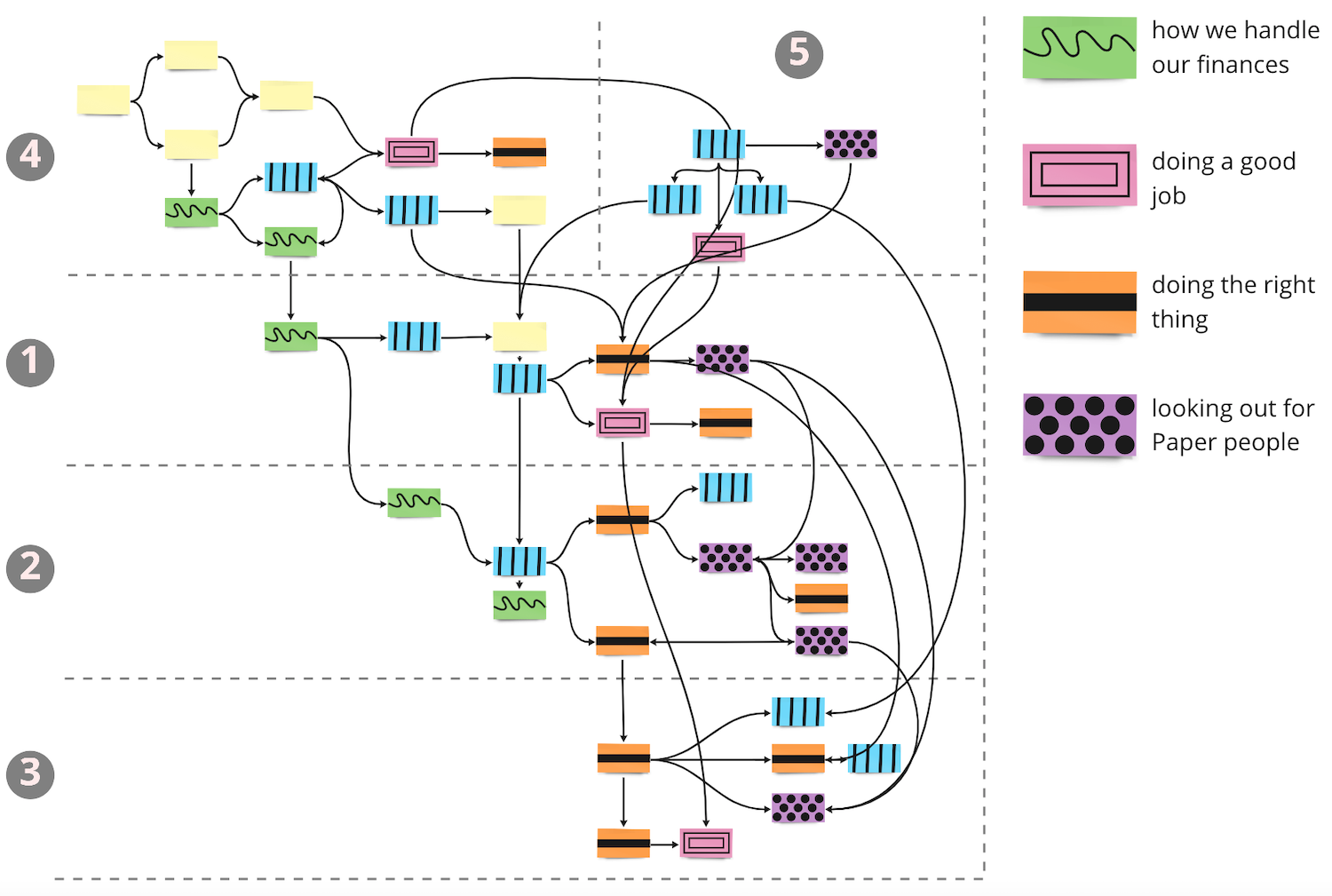
The principles overlapped so much because some covered what we do, like investing in learning or social good projects, while others covered how we make it possible to do those things, like being careful with money and setting aside non-project time. And they all touched a little bit on why we do anything we do.
So to make things clearer, we created a new structure for our post-its to be slotted into as freshly written principles:
- What we do
- How we make sure we can do it
- Why we do it
We highlighted a core message
At the heart of everything any of us talked about during the principles session was a single key theme: people. Whether it’s the people who work at or with Paper, the people who hire our services, or the people who use those people’s services, all roads led back to the potential impact of our business practices and our work on human beings.
We acknowledged how much of a cliché ‘people first’ is, but decided that as long as we had the words and the evidence to show exactly what we mean by it, and that we do mean it, it doesn’t matter if those words alone sound clichéd. We trust that anyone working at Paper and reading the descriptions of our principles will know we’re sincere.

We made ourselves extra clear
We included specific examples of each principle in practice and binned any jargon, replacing it with plain English descriptions. Everyone at Paper got to review the principles, give feedback and make suggestions, and we redrafted until we had a version everyone was happy with.
We spent a long time ironing out what we were trying to say about money and our project selection processes, before thinking carefully about the best words to communicate how we feel. When we used to say we ‘value our principles more than money’ and ‘no loans, no help-me-outs’, it sounded like money wasn’t important to us, like we were flippant about it, but the truth has always been the opposite. Our principles are there because we see the potential money has to influence our decisions if we don’t stay in control of it. They stop us from finding ourselves in a position where we need to prioritise a profit over a person.
Paper’s 6 principles for putting people first
So there you have it. If you’ve read this far you deserve to do a bit more reading! Here are our shiny new principles.
*We published them on the website after all, exactly as they are.
Appendix: Paper’s original founding principles
We value our principles more than money
We will only work on projects that we think are a good fit for us. We sometimes say no. We don’t want to chase revenue by growing a team to deliver cheap work. Our focus is on quality work that meets our principles and makes a difference.
Our profit funds innovation within the business
We’re using profit to ensure that our thinking and skills are up to date, that we are experimental and we remain open to outside influences. At least one day every week we work on innovative or social good projects. This work won’t always be commercially driven, but rather it is focused on curiosity, learning and sharing. Our clients only pay for the days we work on their stuff, and so we fund this work from what would be profit. This doesn’t mean we have built extra margin into our day rate, in fact our day rate is benchmarked to ensure that it is competitive.
We value leg-ups and free work
We want to make a positive difference. We think that by making this one of our 4 founding principles it is as integral to our business as any of the others. To deliver on the principle we provide free leg ups to charities, small business and social enterprises. Some of the leg ups are one-off projects and the others are provided via our free-to-attend mentoring event called leg.up social in which volunteer mentors from the digital community provide support to people who otherwise wouldn’t be able to access it.
Paper is independent and self funded
We’re completely independent. No exclusive partnerships, commission or brownie points from anyone. The three founders self-funded Paper; no loans, no help-me-outs. This means we can help steer clients to the right partners without being restricted.