
 Follow Paper on LinkedIn
Using service blueprinting as a team to get unstuck
For those new to service design, a service blueprint is a diagram that visualises the front-to-back service and the relationships between its different components that are directly tied to a specific user journey. It’s often created collaboratively with your team to create a shared understanding of the bigger picture, enable better communication internal and external to the team, and help identify and communicate opportunities and decisions.
The magic of service blueprinting is all found in the doing. The blueprint becomes a conversation starter, and as service designers who often lead strategic thinking, we can embrace the versatility of a service blueprint to facilitate those conversations. We can then begin to set the direction for how our improved or new service will be implemented and used.
This article explains how we used service blueprinting in our recent project, Secure DfE Data, a 5-month discovery looking into the experience of Department for Education (DfE) internal teams using the departmental information security assurance model.
Why did we use service blueprinting?
There were a few reasons why I felt that service blueprinting would be suitable for this project;
- Break down silos and encourage collaboration: Most team members were new to agile ways of working and struggling with working collaboratively and in the open as part of a multidisciplinary team.
- Rethink who the user is: There was a misunderstanding of who the user is. Understanding the users and their experience was continuous work, and we needed to be reminded of their pain points and needs when making decisions.
- Focus on the bigger picture: DfE team members and key stakeholders couldn’t quite grasp what a service is and why the current departmental model is not one. They found it challenging to move back from details to see things from a broader perspective.
- To help the team spot opportunities, understand them and propose them to their colleagues: The DfE team members seemed hesitant to make decisions and suggest them to senior stakeholders. They didn’t seem to understand or agree with the problems we had identified through research.
- Visualise complexity: The information security assurance model was hard for users to understand and navigate through. It also had various dependencies with systems across the organisation that we needed to understand and manage.
What did we do and how?
Break down silos and encourage collaboration
This team was new to agile and user-centred ways of working. We, therefore, devoted 2 weeks to coaching our colleagues on what a discovery phase looked like and established our direction for the work. A crucial challenge during this time was getting team members comfortable working in the open. We used our retros to raise awareness of a lack of collaboration and how this might affect the outcome of our work. However, due to the intensity of this discovery, people were struggling to find time to share their work more regularly and invite collaboration.
Our approach: I designed and facilitated a series of service blueprinting sessions with the team. We brought our work and findings together to identify opportunities to research further or test in Alpha. I adapted the service blueprint swimlanes to include the process map, which showed where the assurance process fits into the overall user journey, and a line of knowledge with the pain points identified in user research and the most powerful participants’ quotes.
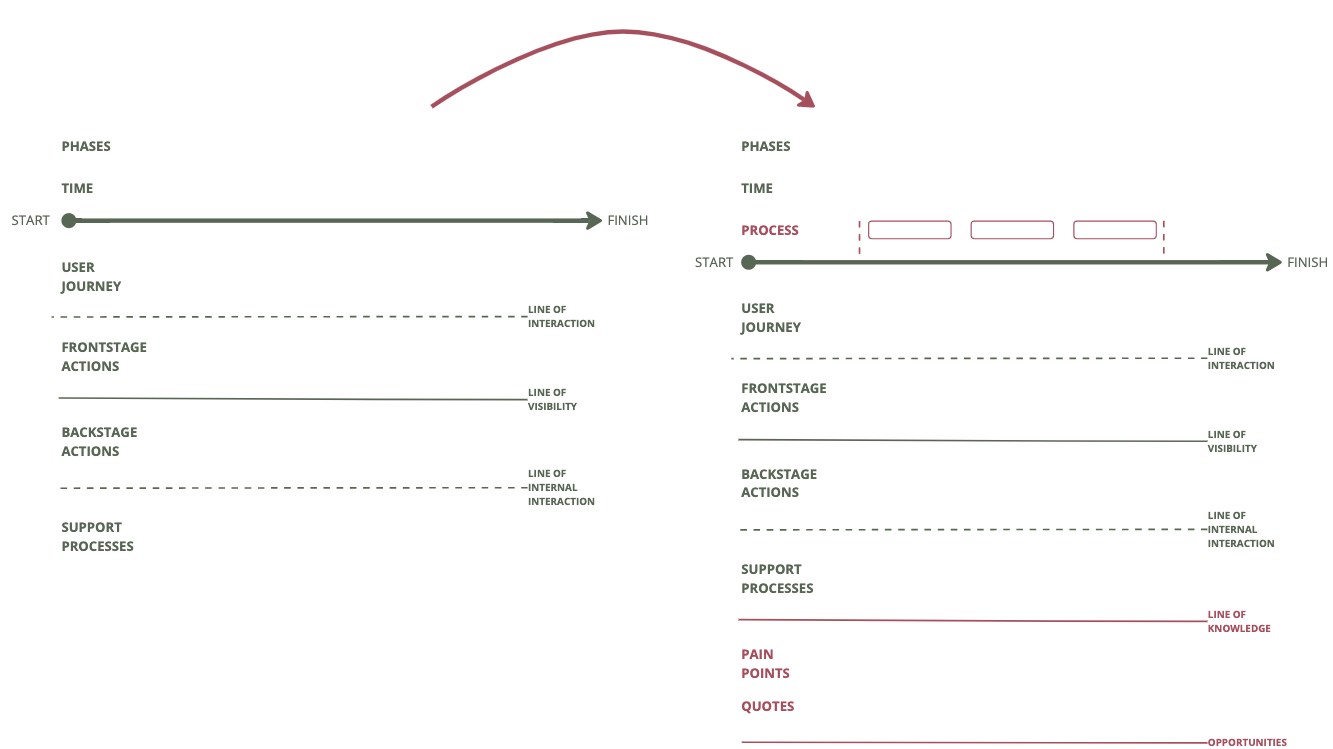
Outcome: This work helped everyone understand the problem from both the user and the business perspective. Also, blueprinting as a team created a sense of ownership and accountability, enabling collaboration and team alignment.
Rethink who the user is
When we entered the project, the team members who had led the pre-discovery work considered information security officers to be the users. Information security officers are responsible for assuring DfE services. Service teams, on the other hand, are the ones who need to make sure that the services they design are secure and provide all the supporting information for service assurance against the HMG standards.
Suppose we put this in the context of a DfE citizen-faced service where schools need to ensure safeguarding is in place. In that case, the service teams are the schools and academies that would need to provide school safety according to the relevant guidelines and policies and the information security officers are the DfE employees who review the evidence submitted by schools and academies to complete assurance.
Our approach: We helped the team understand why service teams are our primary user group through conducting a users and stakeholders prioritisation workshop and user journey mapping sessions. We also actively encouraged all team members to observe research sessions and participate in our analysis and synthesis. However, having members of the information security team in the project team brought bias in prioritising the users and led to some difficult conversations. We needed to reassure Cyber and Information Security Division senior stakeholders and information security officers that our service design and research won’t neglect their needs.
Outcome: Service blueprinting helped us navigate these conversations by bringing the service teams and information security officers’ journeys together in one output. The blueprint visualises how and where they interact, what activities information security officers complete in the background, and how some of their needs and pain points are similar. A shared understanding introduced empathic viewpoints between the service teams and information security officers and mitigated the biases introduced during prioritisation.
Focus on the bigger picture
Although my work in discovery focussed a lot on understanding how the assurance model fits into the broader ecosystem at the DfE and the users’ whole journey, DfE team members and stakeholders had a narrow focus on the project’s scope, preventing us from making improvements by leveraging all possible opportunities within the entire user journey. I, therefore, had to get the team to zoom out and understand the bigger picture, so that we could solve the whole problem for the users, and co-creation helped me achieve just that.
Our approach: I designed and facilitated 5 blueprinting sessions with the team. All team members had an active role in the sessions;
- The business analyst brought the as-is process map and the pain points they’d collected from stakeholders
- The user researcher brought a list of the teams, processes, policies and systems that were mentioned in the interviews and they advised of where there are user needs and pain points across the journey
- The subject matter experts were there to provide their expertise in some areas we were lacking knowledge
We used the first three sessions to fill in the blueprint. In the fourth session, we did some blue sky thinking where we collectively identified opportunities stepping away from the details, and in the last session we prioritised the opportunities and created a plan of action.
Outcome: Although the client team and stakeholders initially considered everything outside the assurance journey out of scope, blueprinting as a team identified an opportunity to expand the project’s scope, looking to implement changes earlier in a user’s journey to improve their awareness of the requirement to go through the security process.
Help the team spot opportunities, understand them and propose them to their colleagues
As with any project, DfE team members and stakeholders already had specific solutions in mind and enthusiastically sought evidence to confirm those.
Our approach: Managing confirmation bias when facilitating opportunities spotting and prioritisation sessions can be tricky, and adapting the template of the classic blueprint with research findings helped to keep the conversation focussed on the user while looking for opportunities to research or test in Alpha.
Through blueprinting, we identified 15 opportunities, many of which were opportunities to research further which we framed as assumptions. This work indicated many gaps in our knowledge and that we needed to extend the discovery to speak to more user groups and create a better understanding to support our Alpha planning.
Outcome: Having our delivery manager involved in this work helped them feel more confident communicating the decisions we collectively made based on evidence to senior stakeholders. Also, sharing the service blueprinting work and learnings helped influence them to support our decision to change our scope and extend discovery.
Visualise complexity
We all knew the assurance process was complex, but not everyone understood the whole picture. Journey mapping helped us identify the pain points from start to finish, but that wasn’t enough. We wanted to understand the role of the processes, teams, systems, and policies mentioned in the research sessions and how they affect information security assurance.
Our approach: The research found a general lack of understanding of DfE governance processes and service blueprinting helped us understand how disconnected those were. Similar pain points emerged across different governance processes, and many of the opportunities we identified depended on other projects and services. The more information we added to the blueprint, the more complex it became, and although it was difficult to make sense of the service blueprint, anyone with a minimum understanding of the service could quickly realise how broken the existing service was and the areas we should focus on improving.
Outcome: Blueprinting highlighted that we needed to work with the teams owning the processes and systems that Secure DfE Data depended on. We needed to understand the problem holistically and how we could work together to solve it. We also documented the risks of not doing so and communicated to stakeholders how they might affect our service so that we could work together on mitigating them.
Keeping the work evolving
Service blueprints are ‘living’ artefacts; we kept iterating ours throughout the extended discovery until we felt we’d gained enough knowledge to start mapping out our ‘to-be’ service. We then used it to frame our problem through ‘How might we?’ statements and thoughts toward potential solutions to test in Alpha. This work helped us form 12 hypothesis statements. We prioritised those and picked out our three riskiest ones to test in Alpha.