
 Follow Paper on LinkedIn
Approaching systemic changes in government
I was always interested in systems, how they connect, what they are, how they work and how we can work on problems in them.
The biggest part of why I’m interested in systems is the complexity of them. Complexity can be found in every stage of a system, even on the basis of describing what a system is. For example our bodies are systems of organs, nerves, cells, bones, different fluids, thoughts, hormones… and many other things. They are all working and connecting in different ways to enable us to function. We all are our own systems, living and working in systems and are surrounded by systems.
With my latest project I had an opportunity to work on a Department for Education (DfE) system and its systemic changes. It ended up as a perfect opportunity to practise my service design skills on a system level. It was everything I wanted: complex, layered and with multiple perspectives to look at the different problems. What project am I talking about? An 8 week long discovery into the Department for Educations (DfE) Vacancy Authorisation, Recruitment, Joiners, Movers and Leavers system. I took on a challenge of practising service design in a system and in this article I will be sharing what I have done.
Why have I been brought in?
As any big organisation DfE has its own recruitment cycle starting with authorising new roles, followed by Recruitment and Joiners stages, and then moving into either Movers or Leavers stage (the whole system is also known as RJML - the A for authorisation is silent in the acronym).
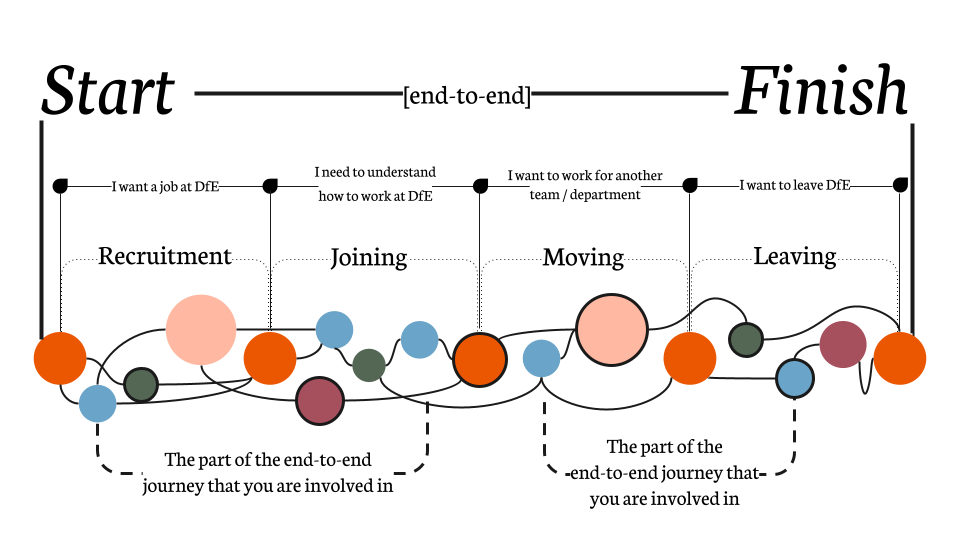
It can be imagined that the processes in each of the above stages are complex and layered with different programs, processes and teams that are supporting the existence and work of the system. Until now the whole end-to-end system hadn’t been mapped which meant the teams didn’t understand how it’s all joined, how stages work together, where are the pain points, problems and how they can be solved on a system level. As much as the individual teams have been working on improving their own processes, the majority of improvements and work was siloed. The RJML team (my projects team, responsible for the overview of the system) worked hard to try to improve the collaboration. They spent 9 months prior to my arrival working with all the different teams involved in the RJML system: helping them understand why they need to collaborate with each other and why they need to see not just their own parts and processes but also how they are connecting with other teams, and how they are improving the system for its users. This is why DfE has brought in a service designer (me) to help them tackle this wicked problem.
What have we done and how?
Currently there are 10 teams that are supporting and working in the RJML system making sure that users are able to go through different stages of the system and have as smooth of a run through it as possible. They are working in their own silos and are using different programs and systems to support their own parts. They have an understanding of their own part but little awareness of other teams’ work, and processes. In order to get an end-to-end understanding I have done these things:
Firstly I wanted to achieve understanding of individual teams’ processes. In order to do so I have spoken to all of the teams and got their processes mapped out into the end-to-end system. See how they are working, what they need to do and where they are struggling. I have started the work with workshops that helped me unpick the different processes of each of the teams. What they are responsible for, what programs and systems they are using and in what stages of the system they are involved in.
These workshops helped me map out the base structure of the processes that are currently being used in the system. I wanted to present the system in a way that teams could see their own processes and other teams’ processes. I have used a service map as my base for the process map but adapted the different lanes into process lanes for different teams to showcase how they are connecting and what processes are done when in the system. Below image showcases how the end-to-end graph of a system got translated into a service map.

To make sure that the map of the system is as accurate as possible I asked for more time for people where I felt there are gaps or things have to be clarified. I have taken my time to make sure that the process is reflecting the current stage of the system, add in any existing work on improvements that teams are already working on, opportunities and gaps.
The current map of the system helped me observe opportunities and problem areas in the current system. This work made me discover that different teams involved in the RJML system have a good understanding of problems but struggle to approach them in co-creative ways beyond siloed work inside their own processes. That helped me understand how I can support systemic changes for RJML not through showing the teams and stakeholders where the problems are but rather with helping the teams break the silos and work together. I have presented my findings (the problem areas as well as my understanding of teams needing support to work together) to stakeholders on different levels.
Getting buy-in from stakeholders
I spoke to the Director General (DG) and directors about how to achieve systemic changes. They need to embed ways of collaborative working as their ways of working. Not see individual improvements of the system as a goal. The goal for them is to make sure that the teams working in the system are able to spot the problem and opportunities, have the tools and methods to work on them together as a collective, are able to test different ideas, identify the best one that will fit with requirements (user needs, business needs, governance and policies) and implement that idea into the system. The directors were eager to see solutions, improvements, but the teams didn’t have the time needed to do the work. Teams need directors to give them time to actually work on improvements, not just work on improvements a few hours per week or even less. Directors need to learn how much time things take and how busy people are with their day to day work. They need to give time and space to teams to work together on system changes.
I spoken to team representatives (Deputy Directors from each team working in the RJML system) on a biweekly basis in the Oversight Group meeting, where I have informed them of my project intent, progress and plans in which I intend to proceed with the project. I wanted their input and thinking so that we could build a relationship where we can work together and they can see first hand what I’m up to as well as how. I wanted to build a good base for co-creation and these biweekly meetings were the space where I tried to do so. In one of these meetings I have introduced 3 opportunity areas that presented opportunities to tackle together. I wanted the stakeholders (the team representatives) to work together and find an opportunity that they feel they can try to tackle together.
Co-creation with the RJML teams
Part of finding the opportunity they could tackle as a collective was them thinking who from their teams could be involved in the co-creation session working on the opportunity. In this setting they were encouraged to take responsibility as a collective on what opportunity was worked on as well as people who could work on it (giving the people who would be involved in co-creation time and space to be involved). Finding the opportunity that we could start with to trial this way of working wasn’t as easy as I hoped and I have luckily found out why it didn’t work out as planned, which was a good learning experience (maybe one that could be its own article). In the end we did find an opportunity that we could work on in a co-creation session. People who were suggested to us by the Oversight Group stakeholders were invited to participate in our co-creation session. In the session we looked at the problems surrounding the opportunity area and thought about ideas without boundaries. If we could think with the mindset that everything is possible, what could we do? It was hard for people to get into that mindset, which was expected as this session was their first dip into the co-creation sea. However we still managed to create 2 opportunity cards with ideas that the team can take into more research and prototyping.
What came out of the 8 weeks?
Unfortunately my 8 weeks concluded before we could go to prototyping. It was always planned to stop at this point. One of my deliverables for the project was to leave the RJML team with a plan on how they can proceed with work that was uncovered through my 8 weeks. We sat down, got the system map on a wall (yes we went back to analog paper and post-its) and made a plan of how this project will continue. The plan we made was presented to the stakeholders to share the accountability for delivery of the work amongst them as well as the core team. They are working on 3 workstreams and different opportunity areas that they can tackle as a collective: focusing on gaining more understanding of users through user research projects, collecting data that can help them in decision making, continuing on work that we have started in our co- creation session and practising ways of working that will help them work on other problem areas that were discovered.
I have great hope for the RJML team to keep up with the work and bring systemic changes into the RJML system as a collective. It’s amazing to see as well as be a part of DfE bringing service designers in sooner rather than later in discovering their systems and problems. It helps create better conditions, understanding and projects for teams to work on that are underlined with user needs and an already valuable understanding of the current situation.
I hope this was just one of many systemic projects I will be working on and if you want to read about my learning of system changes in government here is the link for my second article I have written from working on this project.