
 Follow Paper on LinkedIn
What happens when your discovery goal hasn't already been set
We’ve previously written an overview of the Discovery we did earlier in the year with Leeds City Council, but we wanted to look at one particular aspect in a bit more detail: what happens when you start a project where the goal hasn’t already been set?
When we began working with the council, we were presented with a fairly complex situation:
- A sector (local government) that the Paper team had very little experience in
- A large council department - confusingly referred to as a ‘service’ - that was home to multiple service lines (such as investigating rogues landlords or licensing houses in multiple occupation) and cross-functional teams
- Recognition from the department that they faced a number of challenges, but no agreed direction for the Discovery
- Some services that crossed over into other departments
It was certainly a challenging start, but by no means disheartening. This was a department who were recognised nationally for their work, were at the forefront of shaping central government policy and were staffed by a diverse and highly motivated team.
What we needed
We needed to define the problem we were going to focus our Discovery on, so we set a goal for our inception sprint (one week) to agree a goal for Discovery that was:
- Clearly defined and understood by the Discovery team and council stakeholders
- Achievable in the time available
- Going to be the best use of our time based on the impact we were likely to have
How we approached things
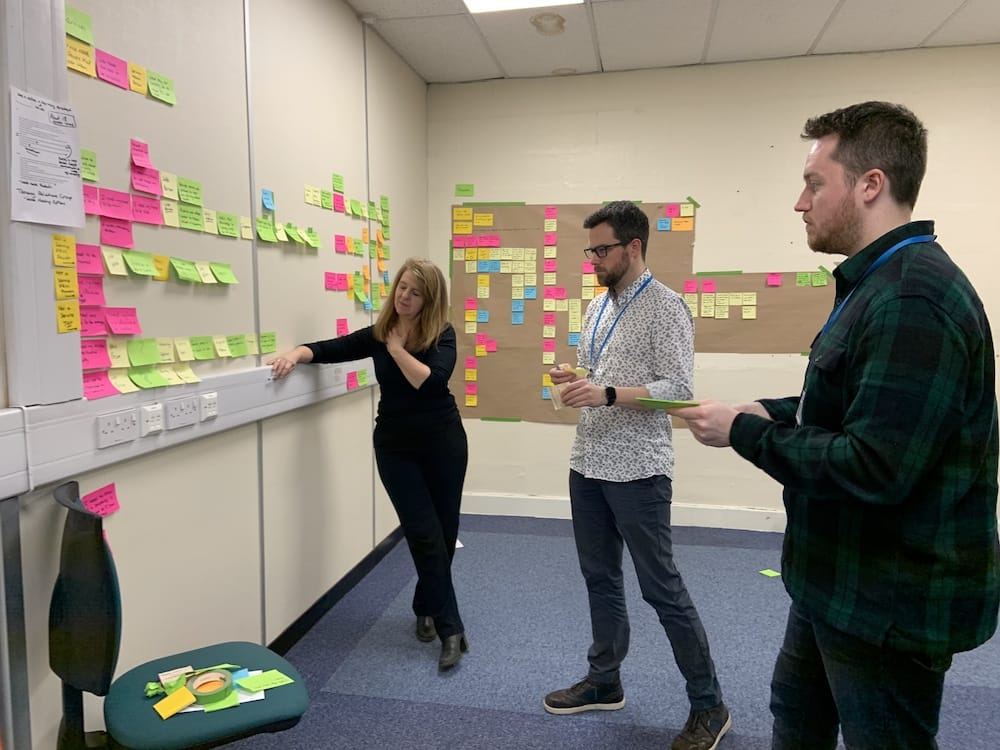
In order to pick a service line for our Discovery we needed to know, at a high level, what all the different services were.
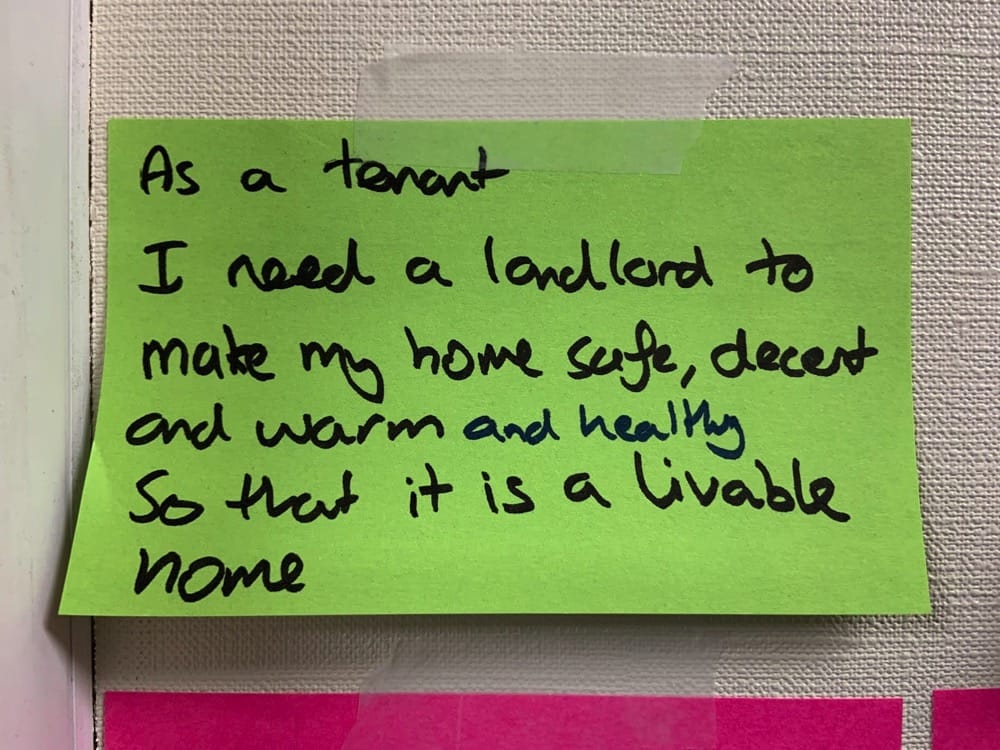
We started mapping out one of the services, but ended up going into far too much detail as we were trying to capture every interaction and potential outcome. We realised that it wasn’t feasible to do this for every service, so we had to change tack. The approach we settled on was to describe each service from a user’s perspective, as a user story1, and then map out the basic interactions and who they involved.
As we went through each service, we highlighted potential issues (opportunities for improvement) and unknowns, but also noted where there were a lot of well defined needs and issues. This last bit helped us later on to filter out services where it was unlikely that involvement from Paper would significantly improve the outcome over the council working on improving those services without us.
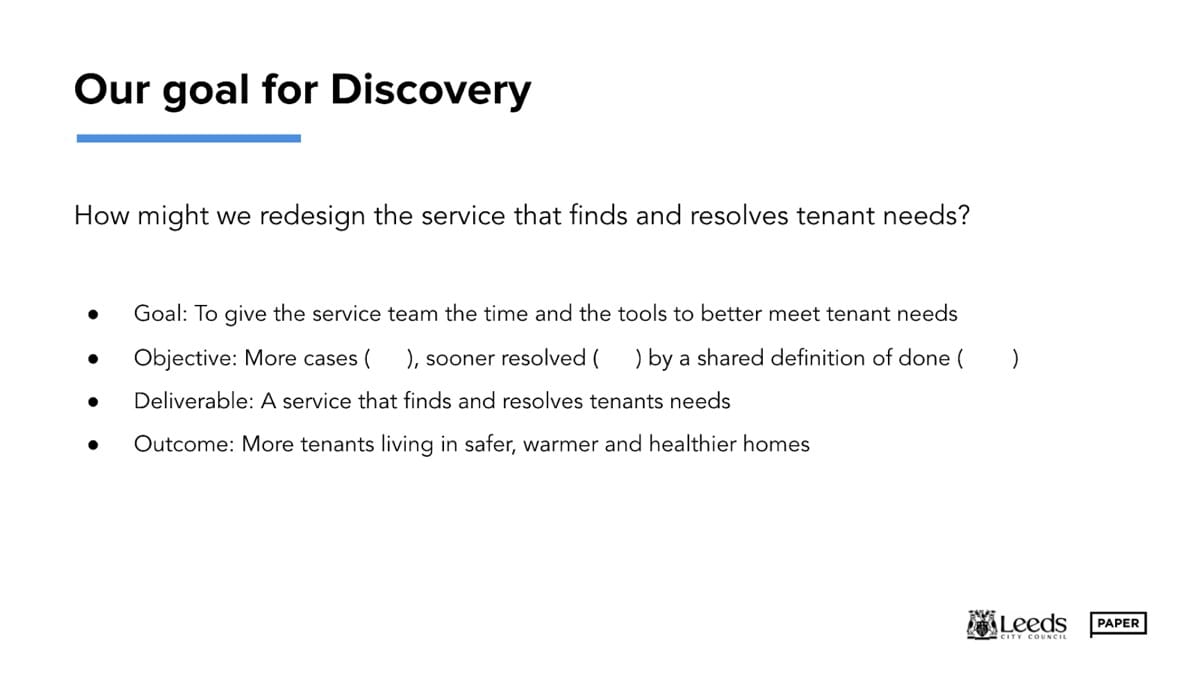
Once we had an idea of where we thought we could make the biggest difference, we took our shortlist of services and broke them down as far as we could using a handy framework from Jamie Arnold, defining the Goal, Objective, Deliverable and Outcome for each one. This helped us better understand the opportunity within each service.
We were able to get to this point through a combination of some early, unstructured research with the service team and a lot of input and guidance from our product owner. Now we had five fairly robust opportunities for a Discovery, we brought in our service owner and talked through each one with them. The service owner was able to provide another valuable layer of context, suggesting where certain services were likely to be affected by upcoming legislation, or where a service crossed into another department and it wouldn’t be feasible to get decision makers involved in a Discovery with no notice.
This left us with one standout service where we all agreed that we could do a piece of work that would produce evidence-based recommendations for improvement that were actionable by the council.
So back to our inception week goal - did we meet it? Yes. Just. But we could have easily failed to meet it and spent a lot longer trying to agree a clear direction. There were a number of things that were crucial to us succeeding. Take any one of these away and we’d have probably failed.
- Although no one from the council had been through this process before, they were well aware of the scale and complexity of the services covered by their department and there was never any question about us trying to look into/at everything.
- The whole team (Paper and our colleagues at the council) got behind the goal and weren’t distracted by other things. We had a notion that we might get into some early research planning by the end of the week, but we didn’t and that was fine - we prioritised.
- We had an incredibly knowledgeable product owner who was able to answer the vast majority of our questions (and there were a lot) and when they couldn’t, they were able to very quickly get us access to the people who could.
- Our stakeholders at the council put complete trust in the process we went through to arrive at our goal.
- We had access to people who were both capable and empowered to make decisions when presented with clear options.
The benefits of this process
On the face of it the situation wasn’t ideal, having to add in an extra step before we could properly kick off the Discovery. It did have some benefits though.
- The council weren’t forced into making a decision for which they weren’t prepared and that would risk the success of the following three months’ work.
- As a team made up of people from Paper and two different areas of the council, we needed to get to know each other, understand each other’s ways of working and agree principles for how the Discovery would run. This was accelerated by the fact that the whole team were working together on the same tasks for the majority of the week, rather than splitting off to do separate planning and setup tasks.
- The process we went through in order to set a Discovery goal gave us a vast amount of useful context. This meant that when we did kick things off, we were better prepared to get straight into planning research, knowing what to ask for and being able to spot rabbit holes that we should avoid.
Notes
-
We made it clear that user stories were unvalidated, but they were a great way for the team to broadly understand what users were trying to achieve. ↩